Writing is a journey, both imaginary and physical. My first book took me to the Arctic to 'catch the colours' of the Northern Lights. Then I hunkered down to catch the wind-blown voices of polar explorers on Shackleton's 1914-17 Endurance expedition. More recently I'm obsessed by space: the race, the rockets, the final frontier.

Hear a BBC Radio Leicester interview about my space poetry at: http://www.bbc.co.uk/programmes/p03wfpyp
Explore my digital narrrative PHILAE'S BOOK OF HOURS, published by the European Space Agency, at:
https://rosetta-art-tribute.tumblr.com/post/144241709712/siobhan-logan-philaes-book-of-hours

My prose-poetry collections FIREBRIDGE TO SKYSHORE
and MAD, HOPELESS & POSSIBLE are both published by Original Plus Press at:
http://thesamsmith.webs.com/originalpluschapbooks.htm

Contact me for signed copies or bookings at:
https://twitter.com/siobsi

Visit the writers' development service I co-run at: https://www.facebook.com/TheWritersShed/


About Me

My photo
Leicester, East Midlands
As a storyteller, my work crosses boundaries of myth, science, history and spoken word. It has been presented in the British Science Museum, Ledbury Poetry Festival, National Space Centre and the European Space Agency website. In 2014 I ran a digital residency on WW1 for 14-18NOW and Writing East Midlands. I teach Creative Writing at De Montfort University and have experience of leading school events, workshop tuition and mentoring. In addition, I co-run The Writers' Shed, a service for writers, at: https://www.facebook.com/TheWritersShed/
Showing posts with label storytelling. Show all posts

Friday, 25 April 2014

Sigrid's Saga

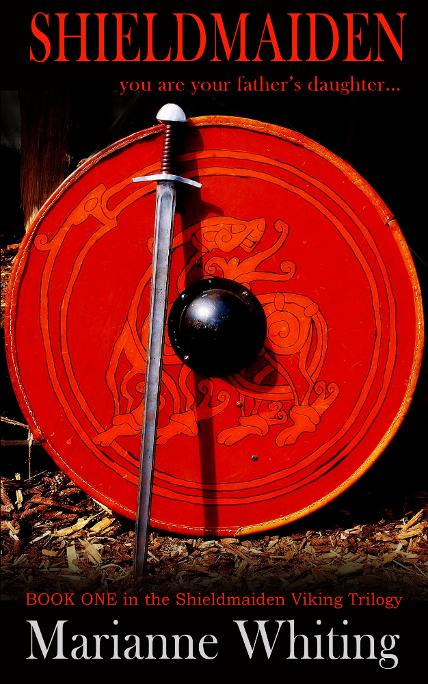
As a storyteller, I have always been fascinated by ancient legends - how different their shaping is, how their heroes don't 'learn lessons' or morality and yet how powerful these early narratives are. On a visit to Iceland some years ago, I stocked up on some wonderful Viking Sagas, packed with passionate characters rooted in real historical landscapes. My holiday reading currently shares a good deal of this territory.  The heroine of Marianne Whiting's 'Shieldmaiden' is a contemporary of poet-warrior Egil Skallagrimsson and also fights at the battle of Brunnanburgh, though on the opposing side. Like Egil's Saga, this tale is unflinching in its depiction of war's chaos and the cruelty of kings. But Whiting's novel has a modern story arc charting the psychological development of its young protagonist Sigrid from her childhood through a bloody and difficult adulthood. The pacing of the narrative is astonishing; in just a few chapters we rush headlong from Sigrid's first crush, through an unhappy marriage, the violent dispersal of her family into exile and her experience of battle and its bitter aftermath. Fans of a rattling good story not short on gory detail, sparky dialogue and strong characters, will be as delighted as I was.

On her website Whiting reveals her excitement at realising that Viking history was one of the few periods when women could arm themselves and play a full part in adventures. Her heroine Sigrid is a gifted warrior, one of the fabled 'shield-maidens' modelled on Thor's own Valkrye daughters. Yet she is much more than a swashbuckling, sword-wielding protagonist. Whiting conveys the full range of Sigrid's experience as a Viking woman living in the Danelaw of Cumbria in 936. She 'knows only too well that look of a man who has seen a woman he wants'. At any time her family or king may decide to use her as a 'peace-weaver' - to forge a politically advantageous marriage. Sigrid negotiates her options as a woman sometimes clumsily, sometimes with a hard-learned dexterity as the vulnerable daughter of a declared traitor. But Whiting also explores her joy in being a lover and mother as well as an increasingly assured leader of men, a 'ring-giver' in her own right. She grows into a legend to match Egil Skallagrimsson, even if she is sceptical about how the reputation of warriors is exaggerated by the bards.


Equally I was impressed by Whiting's subtle but compelling handling of historical detail and landscape. I never once felt the author was 'showing' me some carefully researched detail of Viking lives. Rather we breathe the story through Sigrid's viewpoint and learn to take for granted as she does the Viking system of thralls and karls or bloody sacrifices to the gods, whilst 'discovering' the peculiar practices of Christians now challenging the 'old religion' of the Danelaw. This is what historical fiction can offer beyond the veracity of museums and textbooks - we step into the hand-stitched boots and turbulent emotions of a tenth century Viking woman. I think Whiting's novel benefits too from its vividly-drawn Cumbrian landscapes and recognisable place-names. You feel you could step off a twenty-first century train and hike your way back into Sigrid's world. The novel's sense of place is no less precise or rich in emotional context than the farmsteads and courts of the Icelandic sagas which in part inspired this Swedish author. Her blog makes clear that a sequel is in the offing and also reveals the original impetus for the novel was a vivid dream about her heroine that demanded to be written down. I for one am looking forward to joining Sigrid Kveldulfsdaughter on another Viking quest across the rugged crags of Cumbria or Norway. Meanwhile there's always the VIKINGS TV series to dip into while I wait for Sigrid's return ...

Monday, 24 February 2014

My Writing Process - the Blog Tour

I was delighted to be invited to join in the 'My Writing Process Blog Tour', having always been fascinated to hear how other writers go about their business. My lovely Leicester poet friend Jayne Stanton asked me to follow her in the chain.  You should check out Jayne's posting but here is my own take on the 4 basic questions asked of writers about their 'process':


1) What am I working on?

A collection of poems about the Space Race and the rocketeers who made it happen. Tentative title: Desert Flowers by Moon-fire - The Men Who Raced to Space. Of course, that's really two titles - because I want this book to straddle the poetry and non-fiction divide, as my two previous books did. Having completed a sequence of 32 poems, I'm now working on some prose essays to sit alongside the poetry. My notion is that this is the first of 3 books because I'm itching to get out into space with the astronauts next - and then the Voyager space probe now travelling beyond our solar system. Journeys feature heavily in my work so far from indigenous peoples of the Arctic to Edwardian polar explorers, all navigating extreme landscapes. So it seemed natural to move out into that ultimate wilderness of space ...
 

2) How does my work differ from others of its genre?

Well, if my main genre is poetry, mixing it with non-fiction seems unusual. Fortunately, my editor at OriginalPlus, SamSmith, is a man of many genres himself. In my first book Firebridgeto Skyshore: A Northern Lights Journey, he enabled me to combine lyric poems with travelogues, essays about mythology and science and woodcut illustrations by my sister. My Northern Lights book appealed to aurora enthusiasts as much as poetry lovers and feedback showed the mix of material was appreciated. I'd like my current book to be picked up by space geeks as well as those who want their poetry to transport them in time and place ...
 
 
3) Why do I write what I do?
Some novelist friends asked me recently if I might return to writing fiction which is where I started. But I seem to be addicted to themed poetry collections, each relating an epic tale rooted in history, in 'fact' and biography, in geography and science. In the world of modern poetry, narrativeverse seems rather old-fashioned. But I like to write in sequences which offer a story arc as well as the 'intense moments' and 'micro-universes' of a lyricpoem. It's a challenge to let each poem breathe and not be overwhelmed by the narrative function. But poetry was once THE vehicle of choice for storytelling. Think of those fantastic story-poems by the Romantic poets - TheRime of the Ancient Mariner or Keats' Eve of St Agnes - or go right back to Beowulf or Dante's Inferno. It's the immediacy of voice, the rhythms of the bard 'singing' the story, as well as the intricate patterning of metaphors across a large canvas that I enjoy.


4) How does your writing process work?

With poetry I found myself released from the 'work' of fictionalising into the accessibility of the 'real'. I love the excavation of the historical, the scientific, the biographical - the total immersion in a specific time and place. On reading Hilary Mantel's WolfHall, I realised I too am trying for that richly textured world, the smells and sounds of a culture going about its business. In that 'other country' of the past, I find my imagination breathes differently. So an initial wave of research comes first - books, films, SpaceCentre visits or You-Tube clips. It's amazing what you stumble across on Google Images. I'm writing a poem about the Russian engineer Korolev's childhood - and I find photographs of a museum in his home-town where they've reconstructed his mother's house. These borrowed details become the movie set of my poem, now 'dressed' for action. A poem needs that 'right-there' quality.
After research, there follows a quite intense, rapid period of writing first drafts. I've picked out 'moments' in the story arc that I want to zoom in on, stretching from 1902 to 1977. It takes a few months to get 20 or so poems mapped out. I read them aloud at LeicesterWriters' Club; I need to 'hear' them with an audience of listeners. Then lots of editing. I find poems benefit from being 'left in the dark' like a tray of seedlings for many months. When I return I re-enter the world of the poem afresh and see that it's about something else or has to arrive at a different place. Here dissatisfaction is my best friend. I need to listen to it and stop settling for quick fixes; I need to worry at some of these poems like a dog. Others I need to woo, circle with sidelong glances. Editing is creative too. It takes me in at a deeper level of the excavation. Sometimes all I can see is the rim of the trench, the glint of a coin ...

More research follows - the beauty of the specific often illuminates a poem. I assemble a new palette of words, a semantic field bringing its distinctive music. Yesterday, researching sedan cars from the 30s, I found vintage car dealers onYou-Tube lovingly detailing the selling points of restored models: white-wall tyres, split wind-shields, headlamp buckets and 'suicide doors' now enter my language. Sometimes ready-made metaphors leap out at me. I came across an account of the Cuban Missile Crisis where Korolev's wife served up watermelon to his anxious men. That detail became my 'Martian Watermelon' poem. And that is how poetry can offer a path into history that is wholly different from non-fiction.


http://static.ddmcdn.com/gif/nasa-space-race-2.jpg


I also consider how one poem interacts with another elsewhere in the sequence. Recurring themes and imagery offer a wider textual cohesion that needs tweaking across the collection. Reviewing the story arc - I write new poems to fill in gaps. But by now, the poetry is nearly done and I am turning to prose and even ideas for illustrations. And I am beginning to enjoy the wholly different rhythms of writing non-fiction, the elasticity of this after the compressed music of poetry. Eighteen months on, I am still in the throes of an obsession and I am writing for people who are likewise passionately curious and who love how words sing even in the darkest of stories.
 
Watch this space for news of the 3 writers I've chosen to pick up the baton on this Blog Tour ... First up is  New Romantics 4 novelist Margaret Cullingford:


Margaret Cullingford, Mags to her friends, escaping the rumpus of a university department, decided to generate uproar she could control. She realized a long-term ambition to write fiction, and published her debut novel LastBite of the Cherry [eBook and paperback] in October 2012. Publication of her second novel, Twins of a Gazelle is imminent. Mags lives in Leicestershire with her long-suffering partner and their cat.


Sunday, 6 February 2011

Mad, Hopeless & Possible

sledges packed; huskies fed; maps checked ...


By 2 o'clock in the afternoon, the expedition was underway. In the beautiful space of the Friends Meeting House, with 20 or so hardy companions, I steered into the ice pack of the Weddell Sea. For two hours, we hunkered down to haul the load of this epic story. White Warfare: Shackleton's Endurance Expedition, was my latest show and for the first time, I had travelled South to Antarctica for my inspiration.


It was seats of the pants stuff. A week ago, I was still writing new poems. We only tried out the new projector screen that morning. But thanks to my able techie, Rik, the slideshow ran without a glitch. And I was able to explore how much Frank Hurley's stunning images of ice hummocks and the beset ship added to the poems. (What would he have made of our pocket-sized projector after his enormous Kodak box-camera with its glass plates?) You can still catch an exhibition of his Endurance photographs at the Merseyside Maritime Museum till February 28th. Not to be missed by polar fans.

The event was designed to air the new material, test its mettle. I wanted to see how the whole narrative hung together and it was very useful for me. Lovely to get laughter at certain moments or hear the audience responding to the men's voices - fragments of their own expedition diaries that I was working into the poems. And the balance of illustrated talk with poetry performance seemed to work well.

At half-time, we stopped for cake. Unlike the store-keeper Orde-Lees, nick-named Belly-Burglar by his ship-mates, our cook, Gloria, has never been known to send anyone to bed hungry. We had our fill of her legendary plum-bread and chocolate cake too. Bally fine hoosh!


By that time, in the summer of 1916, Shackleton's Endurance crew had been rescued from Elephant Island. But now we plunged into the much darker story of the Ross Sea Party who had been sent by Shackleton to the other side of Antarctica to lay food depots for his Trans-Continental crossing. The suffering of the the men marooned there for two years belied any of the Boys' Own heroics of the Endurance story. And here were three men Shackleton never bought home. In a darkening hall that was beginning to feel like Polar Night, we hung on for the rescue of the last seven survivors.

My companions stuck with me to the very end. And here were some lovely comments posted afterwards:


It was a really vivid and enthralling description of an extraordinary experience.

Been in the white wilderness so long I now need to go turn on the central heating. No blubber smoke to worry about either.

The poems you read were beautiful and your historical information was
pitched just right...

We were utterly transported ...

... a most joyful afternoon. Marvellous performance!

Monday, 10 January 2011

Saturday Ice


When Shackleton was recruiting for his 1914 Imperial Transarctic Expedition, he filed thousands of applications in piles marked 'Mad, Hopeless & Possible'. It's a good slogan for the whole ill-fated voyage and a wonderful title for a poem - which I've recently written. Perhaps I'm touched with something of the same spirit in deciding to put on an event on a Saturday right between an OFSTED inspection and my own wedding. But I couldn't resist the impulse to seize the moment, while winter's grip hangs on, to tell this astonishing story in poems and pictures.


So here it is. You are invited to a Saturday afternoon of cake, story and pictures. (Yes, Gloria's best plum cake!) Take a voyage into the white beyond and shiver at the men's accounts of icy peril. All of this in the lovely, warm space of Leicester's Quaker Meeting Hall.

WHITE WARFARE: Shackleton's Endurance Expedition

In 1914, as war broke in Europe, Shackleton's ship Endurance sailed for the frozen fields of Antarctica. Intended as one final push acorss the white continent, it turned into an epic and harrowing tale of surival and loss. Now Leicester's 'Polar Poet' tells the story, drawing on the men's own words and images.

Sat. 5th February 2011
2 - 4pm at Quaker Meeting House
16 Queen's Road, Leicester, LE2 1WP
Entry: £3 (includes coffee & cake)


Last night I was watching Bruce Parry on TV venturing out between pack ice in small boats with Inuit hunters. Ice closing in and bergs looming all around. Stunning scenes that recalled the Endurance crew trying to steer their little whaling boats to safety. But Parry explores the impact of climate change and fresh industrialisation on indigenous Arctic peoples as the ice melts quicker than anybody expected. Well worth a look.


And this week, I'm hoping to travel up to Liverpool to see an exhibition of Frank Hurley's wonderful photographs from the expedition. Courtesy of the National Maritime Museum there. More inspiration.

Can you feel that nip of frostbite pinching?

Monday, 4 May 2009

Chocolate Gothic

Imagine a house where every room has a writer tucked into a window seat with notebook or perched with laptop or a whole flock of them huddled in animated discussion. It's a 17th century farmhouse with flagstone floors and each Gothic window opens onto an expansive view of the rolling Cotswolds hills. The house itself is leaking stories – like the adjacent Thimble Cottage, built to house the mad mistress of a long-dead ancestor. Visitors sleep in the turret or rooms with gargoyles under the eaves.

It's the perfect setting for the annual Mayday gathering of the Leicester Writers Club. Here we plot murder and mayhem between communal feasts at the long dining-room table. 'How can we do a car crash on-stage?' one group debates. That's the 'Nuts and Bolts of Scriptwriting' workshop. In another room, someone edits an explosive scene about a Welsh mining community. Later we discuss Writers and Blogging. There are sessions on Writing Dialogue, Editing Your Poem and that writers' nightmare – How to tackle a Synopsis of your Novel.

Several brave souls volunteer to feed sixteen with their best recipes. Let me recall the home-made Polish barley soup, the sausage and pasta supper and the extravagant chocolate cheesecake... And we closed on Sunday with a 'Writing Feast' of the weekend's words. To my surprise, I'd managed a new poem and a monologue inspired by Middle Stanley's railway tunnel. Indeed the house fairly hummed with writing for three days. And in between dinners and redrafts and rambles round the lake – there was a community renewing itself in the shared pleasure of stories. Long may this May-time ritual continue.