Writing is a journey, both imaginary and physical. My first book took me to the Arctic to 'catch the colours' of the Northern Lights. Then I hunkered down to catch the wind-blown voices of polar explorers on Shackleton's 1914-17 Endurance expedition. More recently I'm obsessed by space: the race, the rockets, the final frontier.

Hear a BBC Radio Leicester interview about my space poetry at: http://www.bbc.co.uk/programmes/p03wfpyp
Explore my digital narrrative PHILAE'S BOOK OF HOURS, published by the European Space Agency, at:
https://rosetta-art-tribute.tumblr.com/post/144241709712/siobhan-logan-philaes-book-of-hours

My prose-poetry collections FIREBRIDGE TO SKYSHORE
and MAD, HOPELESS & POSSIBLE are both published by Original Plus Press at:
http://thesamsmith.webs.com/originalpluschapbooks.htm

Contact me for signed copies or bookings at:
https://twitter.com/siobsi

Visit the writers' development service I co-run at: https://www.facebook.com/TheWritersShed/


About Me

My photo
Leicester, East Midlands
As a storyteller, my work crosses boundaries of myth, science, history and spoken word. It has been presented in the British Science Museum, Ledbury Poetry Festival, National Space Centre and the European Space Agency website. In 2014 I ran a digital residency on WW1 for 14-18NOW and Writing East Midlands. I teach Creative Writing at De Montfort University and have experience of leading school events, workshop tuition and mentoring. In addition, I co-run The Writers' Shed, a service for writers, at: https://www.facebook.com/TheWritersShed/
Showing posts with label WW1. Show all posts

Friday, 11 November 2016

Tommy's Scarf

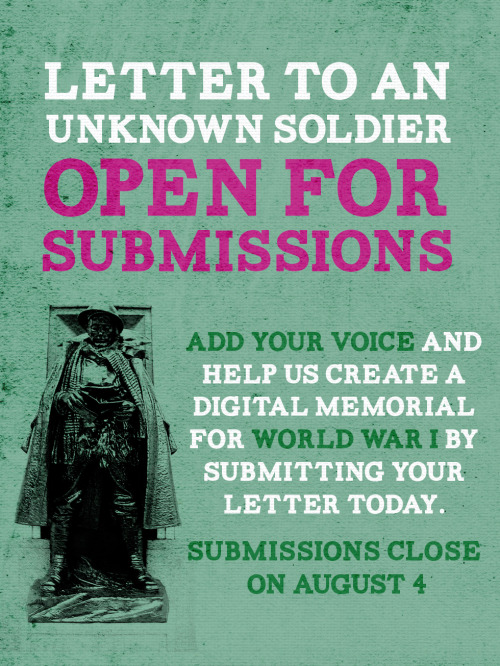
Before the day closes, here is my act of remembrance. Back in 2014, this poem was inspired by the statue of an Unknown Soldier in Paddington Station. The Tommy is wearing a long hand-knit scarf over his uniform and reading a letter, perhaps from home.


Scarf


Her tapped-out knit-one-purl
was a private Morse code
as much lullaby as distress-call
between Field Service Postcards
from France. Her autumn spent
picking up and slipping stitches
to shoulder you from afar.
Today it is a coil of python
a slithering bundle of welted yarn
wrapping your jugular: a ribbed
belt of bullets machine-gun issue
pulling your bowed head to assent.
Then it was a muffler, her umbilical
shawl of twice-ravelled wool
that clicked and twitched
over many a clock-ticked night
into a candlewick fabric, elastic
boy-looped, long as a man:
a fleece itching with unsaid words
still warm with smells of her.
Did she cosset you, Tommy?
Fuss and mither you? Dab
spittle to polish you, tidy a wisp
of hair under your trench cap
when you defied her at last
and donned Kitchener's Blue?
Before this tasselled winding-cloth
you lay cat's cradled in a weft
of barbed-wire bindweed
that snagged on her name and stuck
for the two days it took to die.
A jagged casting-off attended by
No Man's rats and bluebottles.
Your fingers laced around her letter
in a certain light, are skeletal
but stubby nails, bent eyelashes
and boy-man jutting chin, are molten
unresolved, alive in metal.


Published in the Letters to an Unknown Soldier Anthology, ed. by Kate Pullinger & Bartlett  Nov. 2014. Written as part of a residency I led for 14-18-NOW and WEM in August 2014.

Friday, 12 September 2014

The Eye in the Door

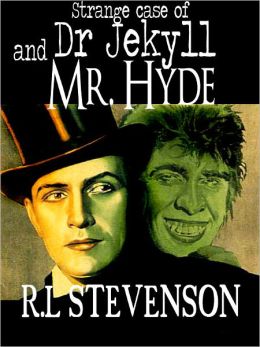
This book is shockingly well-written. Think Dante's Inferno with an undertow of Stevenson's Jekyll & Hyde, bundled into a respectably precise historical novel.  The second in Pat Barker's WW1 Regeneration trilogy, it quickly outstrips the first novel in its revelations about a war we think we know and in its power to move and unnerve us.

The first book, Regeneration was fascinating in its insights into the world of Craiglockhart's military mental hospital and the pioneering treatment of the true-life Dr. Rivers. If you've been impressed and scarred by the poetry of Sassoon and Owen, you'll relish the portrayal of their friendship in this brief haven from the Front. I hadn't realised Owen's poetry was rooted in River's 'dream therapy' as well as Sassoon's editorial eye. The novel probes how the British Establishment declared Sassoon temporarily insane rather than deal with his powerful Declaration Against the War and traces the collusion of his humane and conflicted doctor with that process. I like very much in this novel that we only revisit the landscape of the war itself through the men's night-terrors and memories ceded under hypnosis. Their phobias speak far more loudly than their mutism or stumbled confessions; such as the man who cannot eat at all after his front-line encounter with another man's guts. This distancing device actually made the battle scenes far more terrifying.

Craiglockhart Military Hospital in WW1 -
 http://www.bbc.co.uk/history/worldwars/wwone/wilfred_owen_gallery_06.shtml

But 'Eye in the Door' is a darker beast, if that seems possible, after the trench-bound nightmares of River's patients in Craiglockhart. In the second novel, Barker has melded her forensic period research with her considerable powers as a storyteller to surprise us with a Home Front that is as dystopian as the hell of No Man's Land. This is the world of MI5's pre-cursor, the 'dirty war' of propaganda and spying. As much as Rivers is applying early Freudian techniques to helping his patients defuse their post-traumatic stress, so Barker is probing the twisted psyche of a nation at war with itself. Her story pulls in two landmark court cases that defined the neuroses of an age - the rigged trial of a working-class pacifist woman for allegedly planning the murder of Lloyd George - and a libel trial in which '47,000' of Britain's elite were reckoned to be colluding with the Germans for fear of being exposed as 'sodomites' and 'degenerates'. Barker is very astute about how the cult of masculinity in WW1 threw up this frantically homophobic backlash during the most intense years of the war. Episodes detailing the brutality meted out to conchies and strike-leaders broaden the picture of a state ruthlessly suppressing dissent with some positively Orwellian scenes in prison cells.


However that's just the backdrop - because what really rivets us is the figure of Billy Prior, a soldier home on sick leave, roped into the intelligence service while he struggles to digest the horror that caused his breakdown. Prior proves to be a far more compelling protagonist than Sassoon. A working-class man who achieved officer rank, he is now thrust into the company of the class he so despises. A bitter, angry, caustic yet ambitious soldier, he is secretly terrified by his own hatred of civilians and the violence he senses simmering beneath the surface. To add to his self-loathing, his sexuality is also urgent and aggressive, veering into the 'deviant' in an episode of 'cottaging' that seems all too familiar. Rivers is the one person who can save him, yet their sessions often flip over into a verbal sparring that threatens to drag the doctor's own traumas into the light.

The novel's feverish atmosphere, all graphic social realism shot through with something almost surreal, is heightened by two powerful motifs. The 'Eye in the Door' is a throwback to the shell-shock incident that first unhinged Prior. But it also alludes to his new role as a spy in the service of an increasingly repressive state. And then there is the Jekyll and Hyde allusion, which not only attaches itself to Prior's bouts of memory loss but seems to say something about the whole culture of soldiers disassociating themselves from the violence of combat, as Rivers realises.

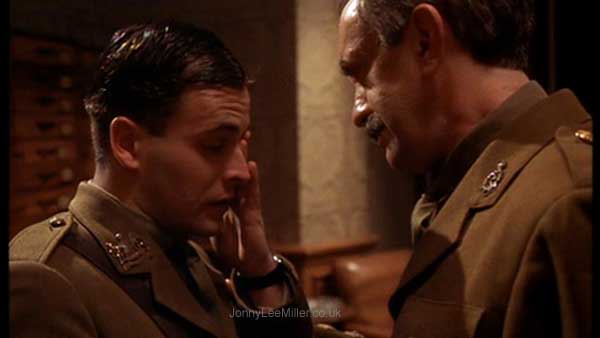
Johnny Lee Miller & Jonathon Pryce as Prior & Rivers in film

The barely contained rage and fear of Prior is a grenade we continually expect to go off in the novel. But he is possibly saner and a good deal more self-aware than the society that has recalled him from the trenches but which will soon re- assess his 'fitness for active service'. Although Barker's war-torn England is a deeply disturbing world, I was reluctant to leave it at the end of this second book and certainly want to see more of both Prior and Rivers in Part Three. Taken as a whole, this trilogy is a towering achievement of storytelling and a fittingly complex response to the catastrophe of the so-called 'Great War'.

Sunday, 17 August 2014

Postcards from a Digital Dug-out


August is a strange month to be sitting in a locked room. Curtains closed to keep the blaze of sunshine from the obscuring the computer's glare. Half-starving, shivering in trenches (imaginatively) whist outside summer burgeons and allotments fatten. But I was excited to be leading my first digital writing residence and for seven days, it felt as if the flickering screen was my patch of sky. When I wasn't googling research sites, jotting exercises or tweeting about it, I was waiting for the cheep of e-borne post. The residency was commissioned by WritingEast Midlands in conjunction with a national body responsible for organising suitable cultural commemorations of WW1. Someone in 14-18-NOW had the idea of a unique 'memorial of words' from today's generation and nationwide, schoolchildren, pensioners, squaddies and civilians, writers and other artists, were drafted to pen a Letter tothe Unknown Soldier of Paddington Station.
 
He's an approachable soul. When you get above the height of the marble plinth, he looks like an ordinary young man from your street. In the bulky uniform of a WW1 Private, he wears a voluminous greatcoat and a non-regulation knitted scarf. He is reading a letter and the 14-18-NOW project invited us to write that Letter From Home. But we had seven days to play with so I devised exercises each day on themes around the Paddington statue - or 'our friend Tommy' as we came to call him. Moving through reflections on the STATION, BOOTS, LETTER, HELMET, SCARF, GREATCOAT and MEMORIAL, we edged further and further into his nightmarish world of troop trains, trenches, shell-holes. It was impossible not to be disturbed, horrified and deeply saddened at the industrial slaughter and daily privations these Tommies suffered.


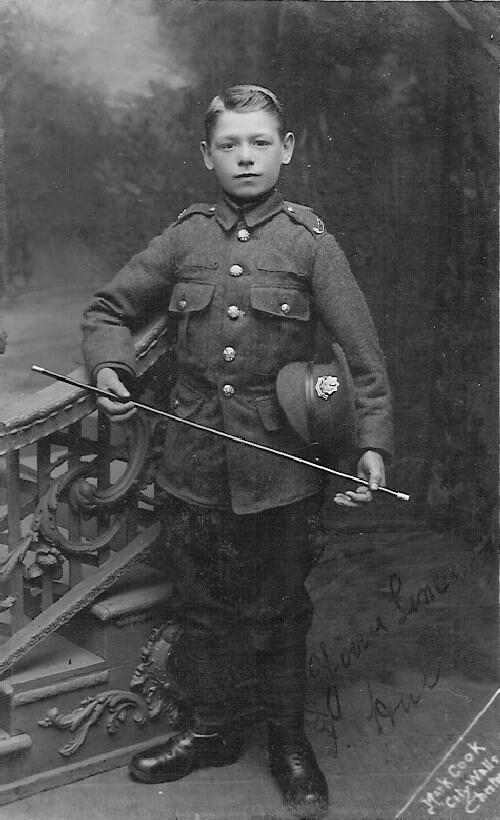
For me, the experience was lightened by the beautiful writing and enthusiastic engagement of the week's work-shoppers. As it turned out, these included some experienced writers, already knowledgeable about WW1. Each day along with writing prompts and exercises, I posted videos, images and web-links garnered from a wide range of on-line sources. We explored the WW1 'field' postal depots and a French cottage industry producing silk  embroidered postcards on a huge scale for soldiers to send home. We wrote about trench foot and shell-shock, about Boy Soldiers (Britain's 250,000 underage recruits) and dawn executions. My 'posties' delivered witty, insightful and moving accounts of desert bombing raids, 'Munitionettes' and life on the Home Front too. After all, this 'Total War' not only spanned the globe but revolutionised social and gender relations as well as the technology of killing human beings in unforeseen numbers.

A century on, a digital writing course is probably a fitting venture for 2014. The unpredictability of who and when was a challenge for me but the flexibility was appealing to workshoppers. With open access 24/7, they could pick through which of the resources and exercises they wanted to tackle and post when they were ready. An attempt at 'live workshops' faltered – it proved better for people to work at their own pace. But they could share the 'texts' they produced – poems, stories, dialogue fragments – and converse with each other via forumthreads. I critiqued each piece posted but also found their feedback invaluable on my own attempts at exercises. So fruitful was this, that subsequently I have drafted a dozen 'Unknown Soldier' poems. An unexpected bonus.
 
When we emerged blinking from this digital dug-out, it was the 4th August. We were posting our final Letters just as the nation marked the 100thanniversary of the War declaration. A sobering moment. But also the culmination of a week's creativity, exploring our own responses to war, and imaginatively re-entering that charged landscape of the past. I am grateful to WEM for the opportunity and to my 'posties' for their openness to writing challenges, their willingness to venture into some dark places and their companionship. I hope we shall see more of their WW1 writing but you can read their Letters to 'our friend Tommy' along with 21,408 others on the 14-18-NOWUnknown Soldier website. They will be available to read there until 2018 when they will be stored permanently in the British Library's digital archive. At which point, our voices and letters will merge into that polyphonic postbag that is our own 'history'.

Monday, 4 August 2014

When the Lights Go out


We've had ... years to think what war is. To me, it's a licence to go out and murder. Why should the British government call me up and take me out to a battlefield to shoot a man I never knew, whose language I couldn't speak? All those lives lost for a war finished over a table. Now what is the sense in that?"

Harry Patch, Britain's Last WW1 veteran in 2004

As part of a writing project, I have been immersing myself recently in documentaries and books and on-line research about the First World War. It's a dark place to go at the best of times. I have been especially moved and frankly disturbed by the testimony of survivors of the trenches who in their final years tried to voice the terrible experiences of their youth. 'LastPost', edited by Max Arthur, brought together interviews with 21 of the last British veterans back in 2005. By now, only their words remain. A good third of these veterans were BoySoldiers, amongst the 250,000 recruited during Kitchener's campaign. In film footage from the Somme and other front-line coverage, these child faces were all too recognisable. And last night I was watching the same generation on TV recounting how they came to be caught up in the 'Pals Regiments' of that war. Raw, heart-breaking accounts of the friends they lost, of the wounded, of the 'wall of bullets whizzing by' as they stumbled over the top.

I am still trying to take in my feelings about all of this as today our WW1 commemorations reach one of those milestones with an evening of broadcasts and the 'LightsOut' campaign. This symbolic appeal to get the nation to switch off at exactly 11pm tonight is an echo of Sir Edward Grey's famous comment: 'The lamps are going out all over Europe, we shall not see them lit again in our lifetime." Grey, as Liberal Foreign Secretary from 1905-16, was part of the Cabinet that unanimously signed the British Declaration of War – so he knew all about that earlier 'switch-off'.

A hundred years ago then, our politicians and generals declared war, along with their counterparts in Europe. As summer waned, they marshalled music-hall acts and sportsmen, viscounts and ministers, editors and poster-makers, to bang the war drums. They handed out white feathers. They promised 'see the world' and 'home by Christmas'. They said they'd 'make a man out of you.' They shamed and applauded and corralled a generation of youngsters into the Recruitment Office. 'You're just the Boys we wanted', said the Sergeant as they arrived. They openly signed up children who 'lied' about their age. (The youngest in this country was twelve.) 'I thought I was a big man,' said William Roberts who joined up at 17, 'but I got a shock.'

They sent Our Boys to the Front often on cattle trains 'with a little straw on the floor'. They shovelled them into trenches to crouch and sleep where they could. Up to their knees in water, under shell-fire, often with little to eat, for days or weeks at a time. The war broke men into pieces but the Army patched them up in military hospitals and sent them back. They didn't only shoot the enemy. They shot men, and children too, at dawn when they fell apart. 'Age no excuse'. 'Shell-shock' something that only happened to officers. Cecil Withers, one of those Boy Soldiers who enlisted at 17, said: 'Our people treated us like dogs. They were cruel bastards compared with the Germans.'

A memorial modelled on 17 year old victim, Private Herbert Burden
 

The undoubted bravery of those who enlisted and their comradeship and lifelong friendships were smothered under horror. Men left crying for help in all languages in No Man's Land. Veterans' descriptions of those scenes will stay with me a long time. And the living too eaten by rats and cockroaches and the inescapable lice. Harry Patch describes how the men clung together and depended on each other:

'I mean, these boys were with you night and day … we belonged to each other. We were a little team together and those men … carrying the ammunition got blown to pieces. It was like losing part of my life. It upset me more than anything.'

The Armies of this 'Great War' invented new weapons and these boys and men on both sides were guinea-pigs for a new technology of killing. Green poison gas. Aerial bombardment. Tanks. The modern age speeded-up even as the war trapped combatants in holes in the ground. Another survivor, Albert Finnegan, decided after the war never to have children, 'I was not prepared to produce cannon fodder for the army, not fodder for industry.'

And the warmongers put off and avoided every opportunity for diplomacy. Until starvation at home and mutiny in the ranks and social revolution across Europe and the collapse of the German Army brought them to a railway carriage. At 5am on 11th November they signed the Armistice. And with the Truce agreed, for another six hours, they still threw men into the line of gun-fire; as many as 11,000 across all Fronts that finalday, just to make the German defeat a little more crushing.
 
This year David Cameron's call for a "commemoration that, like the Diamond Jubilee celebrations, says something about who we are as a people" sparked a NoGlory in War campaign from many of our leading cultural figures. Even Jeremy Paxman, who dismissed 'conchies' as 'cranks' in his own documentary, commented 'Only a moron would 'celebrate' the war." Cameron recently published a Letterto the Unknown Soldier in Paddington Station which says:

'… our world would have been far darker if you had declined the call to act. Without your service, our security, our values, our very way of life would have been lost.'

Darker than this? 16 million dead in 4 years? And who was it who switched off the lights across Europe? This war was planned in gentlemen's clubs, in cabinet rooms, in palaces. They may not have understood what it would unleash but the slaughter was obvious long before Christmas. And still they prosecuted this war for four long years. Today their inheritors stand at Cenotaphs and in Cathedrals and pay their respects. And tomorrow they'll will go back to the business of making war. A part of the 'very way of life' they have never given up.  I believe they would do it again. I really do. If We Forget.