Writing is a journey, both imaginary and physical. My first book took me to the Arctic to 'catch the colours' of the Northern Lights. Then I hunkered down to catch the wind-blown voices of polar explorers on Shackleton's 1914-17 Endurance expedition. More recently I'm obsessed by space: the race, the rockets, the final frontier.

Hear a BBC Radio Leicester interview about my space poetry at: http://www.bbc.co.uk/programmes/p03wfpyp
Explore my digital narrrative PHILAE'S BOOK OF HOURS, published by the European Space Agency, at:
https://rosetta-art-tribute.tumblr.com/post/144241709712/siobhan-logan-philaes-book-of-hours

My prose-poetry collections FIREBRIDGE TO SKYSHORE
and MAD, HOPELESS & POSSIBLE are both published by Original Plus Press at:
http://thesamsmith.webs.com/originalpluschapbooks.htm

Contact me for signed copies or bookings at:
https://twitter.com/siobsi

Visit the writers' development service I co-run at: https://www.facebook.com/TheWritersShed/


About Me

My photo
Leicester, East Midlands
As a storyteller, my work crosses boundaries of myth, science, history and spoken word. It has been presented in the British Science Museum, Ledbury Poetry Festival, National Space Centre and the European Space Agency website. In 2014 I ran a digital residency on WW1 for 14-18NOW and Writing East Midlands. I teach Creative Writing at De Montfort University and have experience of leading school events, workshop tuition and mentoring. In addition, I co-run The Writers' Shed, a service for writers, at: https://www.facebook.com/TheWritersShed/
Showing posts with label 67P. Show all posts

Monday, 12 September 2016

Where PHILAE Boldly Goes ...

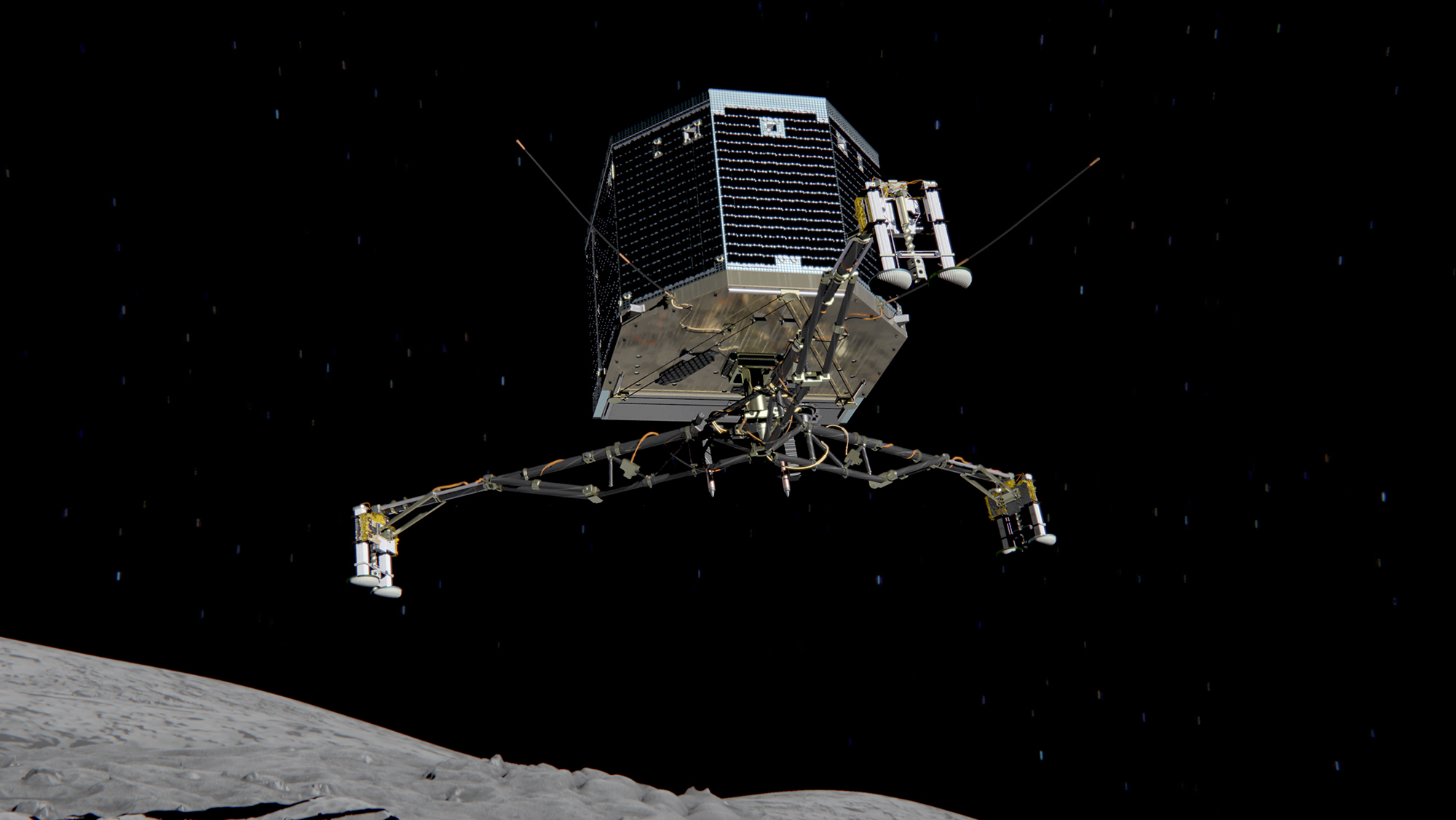
We follow. #AreWeThereYet? What's not to love about a space mission that delivers more drama, danger and comebacks than a sci-fi franchise? Only last week, we got another cliff-hanger as space-craft Rosetta tracked down its long-lost lander Philae. Marvellous as the engineering has been, it's the imagination that's kept me riveted to my desktop porthole. ESA transported us across the solar system via our Twitter-feeds. Beam me down, Scottie. Those razor-sharp OSIRIS photos of comet 67P put me right there, kicking up carbon-dust.
 
 
Where early Egyptians drew constellations on coffin-lids to guide departing souls, ESA let us ride the stars. This virtual adventure inspired me to create a poet's saga for the digital age: Philae's Book of Hours. So Philae is a chattering soul-bird. And though its song has since fallen silent, it had us spellbound in its season. Its cometary resting-place Abydos was named for an ancient cemetery. In Egyptian mythology, after death a human-headed soul-bird flits between the lands of living and dead. I thought of ESA scientists at computers communing across vast distances to their metal avatar in this underworld. But Philae ventured into the dark on our behalf too, an android explorer probing an icy wilderness, an ingenious box of tricks sifting air and dirt for the secrets of creation. And most extraordinary of all, it talked to us. Well-named for an obelisk that unlocked an ancient language, it kept up a stuttering dialogue for days. #LifeOnAComet Its subsequent silence always hummed with the promise of more.
 
'You bide your time, faithful
as a mummified dog... When
you wake at last, Philae
you are babbling to yourself
a snakeskin song of telemetry
a cometary Book of Hours ...'
 
Rosetta is the mother-ship goddess, blue-winged like the protective figure of Isis, who knew a thing or two about resurrections. So whip-smart, quick on its feet, engineering with attitude. Think Princess Leia before the bikini. But this solar-panelled spacecraft could also be sun-god Ra's midnight barge crossing the dangerous realms of the afterlife. When ESA's scientists described the comet's icy jets as a 'living thing, a dragon waking up,' the storyteller in me was hooked. Rosetta's zig-zagging course was a pyramid trajectory. It had to dodge comet 67P's fierce outpourings, just as Ra and his 'crew of gods' had to steer past Apophis, the fire-spitting snake. Surely this is a classic Hero-Quest, a space-voyage in an aluminium boat on a wing and a prayer. Han Solo minus the laser-gun.


And then there is the comet, captured in mesmerising black-and-white shots in all its rugged variety. I am addicted to those OSIRIS close-ups. Tracts of wildernesses marked not by space-boot but by Philae's human-made SESAME feet. I see comet 67P as a book. Let's call it a book of maps, a cartography of 26 alien regions 'named for Gods of the Old Kingdom'. All very Star-Gate. ESA's Egyptian analogy for the space mission finds its fullest expression in their colour-coded maps of 67P's rocky terrains. Rosetta's own burial chamber will be a cometary pit of hell. I love that it's named for Deir-El-Medina, an Egyptian archaeological site filled with tomb-workers' rubble. But the comet is a book of spells too, a book that spits and fires and sings. A book that hides its secrets deep in pages of ice-dirt, in a crease of rock or sudden abyss:
 
'… The comet is spitting creatively
uncharted twinklings, carbon-glints,
constellations of grit, a cosmic
sneeze of light.'
 
Some Earthlings are sad that the mission is drawing to a close.* That we will cease our conversation across space with Rosetta's satellite. No more fly-by postcards from the underworld. No time-delayed messages from the box-robot forever hanging on its cliff. Yes, I'll miss all that. But the scientific stories that Rosetta-Philae gifted us are still being decoded. We will be thumbing the pages of 67P for decades to come. And this space-epic has already become a tale of us at our best, coming together in many languages, to achieve an extraordinary feat. No wonder we painted a face on Philae and begged it to call home. Like the Egyptians, we've daubed this fable on our walls. Rosetta and Philae are celebrated in our poems, rock albums, t-shirts, e-wallpapers, sculptures, cartoons, comet-shoes, installations and origami. They are already legends. As the Pyramid texts promise, 'you have died but you will live.'


* ESA has invited followers of Rosettta & Philae to 'Share your personal experiences and feelings about the mission' on a Rosetta Legacy Page. See: http://rosetta-legacy.tumblr.com/  This blog-post appeared there in September 2016.

Thursday, 13 August 2015

Perihelion Poetry in Motion


Today is PerihelionDay! Scientists at the European Space Agency and beyond will be popping the champagne and donning party hats to mark 'Rosetta'sDay in the Sun'. And many ordinary punters like myself will be joining them on-line as this extraordinary space mission reaches its zenith. What this all means is that comet67P has travelled around in its orbit to reach its closest point to the sun in 6.5 years. As it does so, the sun's heat melts icy deposits in its body or nucleus and so the comet is firing off jets of dust and gas that create the comet's distinctive tail.

Credit ESA: http://blogs.esa.int/rosetta/2015/02/11/new-perspectives-cometwatch-6-february/


As in ancient times, astronomers on Earth can now track the flaming ball with its streamer of light across our night skies. But for the first time in history, we have a spacecraft sitting right on its tail, hitching a ride. And if that's not wondrous enough, there's our trusty Philaerobot snuggled into a cliff wall on the comet itself while all this mayhem kicks off around it. Vicariously, through our machines, we have been getting a front row view of the fireworks show with mesmerising photos of this alien world beamed back every day from Rosetta's cameras. I can't resist the 'we'. Partly because the Rosetta mission does feel like a feat of human ingenuity and curiosity that we can all revel in. And partly because the ESA have been so generous in sharing their data on their website that its possible to feel like you're with them every step of the way. In fact, they recently won an award for their educational programmes around this mission, working with schools and teachers.

Credit ESA: http://www.esa.int/var/esa/storage/images/esa_multimedia/images/2014/02/philae_descent/14277309-1-eng-GB/Philae_descent.jpg


They have also inspired artists like myself. Back in November I was riveted by the unfolding drama of Philae'slanding. Would it smash on the rocky surface? Would it more likely just bounce off and drift into space given the comet's low-gravity? Would it be able to talk to us or be just another dead machine on an alien world? As it was, although it bounced three times and disappeared from view, it managed to lodge under a cliff-face that sheltered it from the heat of advancing perihelion and the fierce jets of material. The scientific mission was highly successful with nearly all its instruments working. For three days Philae ran an on-site laboratory and up-loaded all its packets of data before going 'to sleep' when its solar batteries ran low. 'I'm tired' it tweeted. And then silence. A storyteller could hardly wish for more of an Act One plot point.


Credit: http://www.egyptartsite.com/myth/raboat.jpg


While Philae slept, maybe for good, Rosetta was busy mapping the comet's surface in a series of fly-bys, yielding these spellbinding images. I was fascinated by the ESA's choice of Egyptianmythology to name its '19 regions' as well as the mission itself. When I began to research the old Egyptian stories, they seemed particularly apt. Here was Philae descending into a cometary underworld where it vanished from view, lost in the darkness. And the comet itself was travelling back towards the sun, like the cyclical journeys of the sun-god Ra moving across our skies only to disappear into Duat or the underworld each night. I was moved to write a new poem sequence tracing Rosetta and Philae's adventures on the other side of the solar system. And my narrative is a mash-up of modern space science and the ancient mythology. Here's one of the verses from my 'Egyptian Book of the Hours' for Philae.

9 Duat

'I'm tired,' you twitter
a tin-foil chick alone in the dark
and packets of data dispatched
you burrow into the hide
of a frozen mammoth haunch;
dormant not extinct, you're
descending by robotic barque
into an underworld cyber-space
where a lab-coated Anubis
will weigh your feather-heart.


Two weeks hence, on 1st September, I will be joining scientists and astronomers for our own celebration of Rosetta's mission. 'To Perihelion and Beyond!' will be staged at the NationalSpace Centre in Leicester. Our event will feature poems & performance, science and story, and a 'Build Your own Comet' demo. And my Book of the Hours will be available as a scroll, papyrus style, to cast a spell as we re-live Philae's Descent into Duat. Hopefully it will honour the storytellers of old as well as today's space adventurers.