Writing is a journey, both imaginary and physical. My first book took me to the Arctic to 'catch the colours' of the Northern Lights. Then I hunkered down to catch the wind-blown voices of polar explorers on Shackleton's 1914-17 Endurance expedition. More recently I'm obsessed by space: the race, the rockets, the final frontier.

Hear a BBC Radio Leicester interview about my space poetry at: http://www.bbc.co.uk/programmes/p03wfpyp
Explore my digital narrrative PHILAE'S BOOK OF HOURS, published by the European Space Agency, at:
https://rosetta-art-tribute.tumblr.com/post/144241709712/siobhan-logan-philaes-book-of-hours

My prose-poetry collections FIREBRIDGE TO SKYSHORE
and MAD, HOPELESS & POSSIBLE are both published by Original Plus Press at:
http://thesamsmith.webs.com/originalpluschapbooks.htm

Contact me for signed copies or bookings at:
https://twitter.com/siobsi

Visit the writers' development service I co-run at: https://www.facebook.com/TheWritersShed/


About Me

My photo
Leicester, East Midlands
As a storyteller, my work crosses boundaries of myth, science, history and spoken word. It has been presented in the British Science Museum, Ledbury Poetry Festival, National Space Centre and the European Space Agency website. In 2014 I ran a digital residency on WW1 for 14-18NOW and Writing East Midlands. I teach Creative Writing at De Montfort University and have experience of leading school events, workshop tuition and mentoring. In addition, I co-run The Writers' Shed, a service for writers, at: https://www.facebook.com/TheWritersShed/
Showing posts with label Shackleton's Endurance voyage. Show all posts

Friday, 28 October 2011

Small Press Secrets


A year of immersing myself in the icy world of Antarctica and polar exploration finally bore fruit last night with the launch of my new chapbook, MAD, HOPELESS & POSSIBLE: Shackleton's Endurance Expedition. And not only that but a chance to interview my editor, the lovely Sam Smith of Original Plus books. The event was hosted by Leicester Writers' Club, a wonderful community of writers, and Sam's comments struck a real chord with them.

Sam spilled the beans on how the world of small press publishing looks from the inside. Sam explained that as an aspiring novelist, it took him 23 years to break into print. Editors would accept his books only to find that the salespeople wouldn't run with it. Finally he turned to poetry and got published within months. This fuelled his desire later to get into small press publishing himself as a way of contributing to that community of poets:

'I do it because it was so important to me to get something into print. I wanted to give that opportunity to other writers.'

We discussed the economic realities of small press publishing. This is a one man press - virtually a cottage industry with all the chapbooks printed up at home. With his poetry magazine, The Journal, his biggest cost is postage for subscribers. It's a 'hand-to-mouth' operation and very much a labour-of-love for this dedicated writer and editor. To find out what Sam had to say about how English Poetry changes, what he looks for in submissions and the future of print publishing as e-books take off, have a look at this fascinating interview: http://www.youtube.com/watch?v=k4A-5jCLusw&feature=youtu.be (many thanks to Ambrose Musiyiwa for posting this)


It was timely that as I prepared for this event, I was being captivated all over again by Attenborough's ravishing images of the white continent in FROZEN PLANET on TV. http://www.bbc.co.uk/programmes/b00mfl7n Here were the wind-tortured icescapes, the mighty glaciers and the wild creatures of the South that early polar explorers encountered on foot. Don't miss this beautfiul series. And you can catch readings of my poems inspired by all that magnificence on: http://www.youtube.com/watch?v=w9VusaWXVW4&feature=share&noredirect=1
And if you're wanting to find out more about my book on my website, hang on! My trusty techie is working on a revamped website right now and we will unveil this in a week or so.
So watch this space ... and have a look at Original Plus for this and many other titles. See: http://www.freewebs.com/thesamsmith/originalpluschapbooks.htm

Sunday, 6 February 2011

Mad, Hopeless & Possible

sledges packed; huskies fed; maps checked ...


By 2 o'clock in the afternoon, the expedition was underway. In the beautiful space of the Friends Meeting House, with 20 or so hardy companions, I steered into the ice pack of the Weddell Sea. For two hours, we hunkered down to haul the load of this epic story. White Warfare: Shackleton's Endurance Expedition, was my latest show and for the first time, I had travelled South to Antarctica for my inspiration.


It was seats of the pants stuff. A week ago, I was still writing new poems. We only tried out the new projector screen that morning. But thanks to my able techie, Rik, the slideshow ran without a glitch. And I was able to explore how much Frank Hurley's stunning images of ice hummocks and the beset ship added to the poems. (What would he have made of our pocket-sized projector after his enormous Kodak box-camera with its glass plates?) You can still catch an exhibition of his Endurance photographs at the Merseyside Maritime Museum till February 28th. Not to be missed by polar fans.

The event was designed to air the new material, test its mettle. I wanted to see how the whole narrative hung together and it was very useful for me. Lovely to get laughter at certain moments or hear the audience responding to the men's voices - fragments of their own expedition diaries that I was working into the poems. And the balance of illustrated talk with poetry performance seemed to work well.

At half-time, we stopped for cake. Unlike the store-keeper Orde-Lees, nick-named Belly-Burglar by his ship-mates, our cook, Gloria, has never been known to send anyone to bed hungry. We had our fill of her legendary plum-bread and chocolate cake too. Bally fine hoosh!


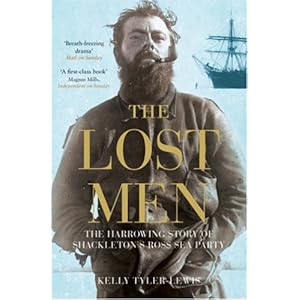
By that time, in the summer of 1916, Shackleton's Endurance crew had been rescued from Elephant Island. But now we plunged into the much darker story of the Ross Sea Party who had been sent by Shackleton to the other side of Antarctica to lay food depots for his Trans-Continental crossing. The suffering of the the men marooned there for two years belied any of the Boys' Own heroics of the Endurance story. And here were three men Shackleton never bought home. In a darkening hall that was beginning to feel like Polar Night, we hung on for the rescue of the last seven survivors.

My companions stuck with me to the very end. And here were some lovely comments posted afterwards:


It was a really vivid and enthralling description of an extraordinary experience.

Been in the white wilderness so long I now need to go turn on the central heating. No blubber smoke to worry about either.

The poems you read were beautiful and your historical information was
pitched just right...

We were utterly transported ...

... a most joyful afternoon. Marvellous performance!

Wednesday, 26 January 2011

Ice Floe Drifting

Wedding maps and menus are being posted as we speak, OFSTED paperwork is piling up for this week's inspection and my poetry event on Shackleton's Endurance story is not much more than a week away. Yikes! January is indeed a full-on month.

But I was given a huge boost recently when the editor of my Northern Lights book, Firebridge to Skyshore, offered to publish this new collection of poems as a chapbook. Sam Smith did a great job on my first book and I'm thrilled that this new sequence will find a home and a pathway into print with Original Plus Press. Look out for news of that later in the year.

That gives even more impetus to my frantic editing. Although I'm also finding myself writing new poems to round the sequence off - five in the past fortnight. I've been workshopping as many as possible at Leicester Writers' Club and this week at the new Poetry Stanza group in Leicester. This group of poetry enthusiasts offer detailed critiquing off the page so was very useful.

So I have to reflect on my great good fortune - not only to have an editor who is so supportive of my work but to live in a city where literature/writing groups abound. This week, I'm hoping to make it along to the women's poetry group Soundswrite, who are also bringing out a new anthology this year that will feature 3 of my poems.

Meanwhile, as Caroline of Stanza said, I am still on my ice floe. Here's a poem in progress:


WHITE WARFARE

they set off
to hoist a blue flag
in an empty country
a jagged ice-barbed
no-man's land

nineteen hundred
and seventeen
was a speck in the long
geological calendar
of the continent

which resumed
its freezing, melting, fastening
throes; its volcanoes
smudging black funnels
of smoke on livid skies ...

(to be continued )

Monday, 17 January 2011

Glass Plate Visions

These days many of my weekend breaks are research trips: Cardiff, Iceland - and now Liverpool. It was my first time in the city and I was here for an exhibition of photographs from the 1914 Shackleton Endurance expedition. The Albert Docks were beautiful on this bright January day and I wished we'd had more time to explore. The Maritime Museum was also very impressive with exhibitions on the Titanic, on Slavery, Art and the Sea as well as Shackleton. All good reasons in themselves to come here again but the Shackleton exhibition was so spectacular, it kept me busy for two and a half hours.


There seemed to be hundreds of photographs, all printed from Frank Hurley's original plate negatives. I learned so much about the expedition from trawling through them. And useful snippets from the men's diaries alongside. Even maps of the period were fascinating. In previous centuries, Antarctica was either completely missing from the map or 'the white edge' with no detail - the guessed-at continent. Explorers such as Shackleton had only been probing its shores for a few decades and were filling in the maps as they went.


The photographs painted a vivid picture of the hardships of the men, of their camaraderie and their increasingly desperate plight. But what shone through was the vision - literally - and the passion of one man, the remarkable Frank Hurley, a gifted photographer working at the cutting edge of his art in that era. So enthralled was he by what he saw, he even dived into the freezing waters of the sinking ship's hold to retrieve these plates. Inevitably, I started jotting a poem on the spot:


He loved the ice, this man,
laid his eyes upon it
with an illuminating caress;
sugar surface, snow pebbles, ice caves, stalactites ...
even when it defeated
them, wrenched them, imperilled
and appalled them,
he kept faith
stealing back with his tripod and plates
to spread his gaze
over its infinite broken form
its sea-changing, melting magnificence ...


I love a good museum and was astonished that this wonderful exhibition was entirely for FREE. Long may places like the Merseyside Maritime Museum escape the grasping fingers of government cuts and offer such treasures to all. I shall certainly hope to return to Liverpool.

Monday, 10 January 2011

Saturday Ice


When Shackleton was recruiting for his 1914 Imperial Transarctic Expedition, he filed thousands of applications in piles marked 'Mad, Hopeless & Possible'. It's a good slogan for the whole ill-fated voyage and a wonderful title for a poem - which I've recently written. Perhaps I'm touched with something of the same spirit in deciding to put on an event on a Saturday right between an OFSTED inspection and my own wedding. But I couldn't resist the impulse to seize the moment, while winter's grip hangs on, to tell this astonishing story in poems and pictures.


So here it is. You are invited to a Saturday afternoon of cake, story and pictures. (Yes, Gloria's best plum cake!) Take a voyage into the white beyond and shiver at the men's accounts of icy peril. All of this in the lovely, warm space of Leicester's Quaker Meeting Hall.

WHITE WARFARE: Shackleton's Endurance Expedition

In 1914, as war broke in Europe, Shackleton's ship Endurance sailed for the frozen fields of Antarctica. Intended as one final push acorss the white continent, it turned into an epic and harrowing tale of surival and loss. Now Leicester's 'Polar Poet' tells the story, drawing on the men's own words and images.

Sat. 5th February 2011
2 - 4pm at Quaker Meeting House
16 Queen's Road, Leicester, LE2 1WP
Entry: £3 (includes coffee & cake)


Last night I was watching Bruce Parry on TV venturing out between pack ice in small boats with Inuit hunters. Ice closing in and bergs looming all around. Stunning scenes that recalled the Endurance crew trying to steer their little whaling boats to safety. But Parry explores the impact of climate change and fresh industrialisation on indigenous Arctic peoples as the ice melts quicker than anybody expected. Well worth a look.


And this week, I'm hoping to travel up to Liverpool to see an exhibition of Frank Hurley's wonderful photographs from the expedition. Courtesy of the National Maritime Museum there. More inspiration.

Can you feel that nip of frostbite pinching?

Wednesday, 29 December 2010

Listening for Ice

While the post-Christmas thaw sets in here with its slush and grey skies, I've been hibernating in a corner of Antarctica. Mornings huddled over my Shackleton poems, wrestling sea leopards, hauling boats across hummocks, listening to the sounds of ice pressure and Emperor Penguins. Sometimes I don't even make it out of my pyjamas. The opportunity to fully immerse myself in this alien landscape, in the detail of the story, is too precious to squander.

Progress north is good so far. A dozen poems more or less edited, three new ones bashed out to plug some gaps in the narrative. Because it's all about story, this sequence - a staggering tale of 28 men drifting backwards and forwards in the pack ice while another party of 10 braved the worst conditions of the continent to lay food depots for an Imperial Transcontinental expedition that literally never got off the ground. The kind of winter tale you can really lose yourself in.

This afternoon, I'm checking out the scavenging habits of skuas, the blow-holes of killer whales and terms for ships's parts and ice-bergs. Binnacle for instance; and growlers, bergie-bits and brash ice. These words lend a particular texture and even music to the poems. I'm also trying to channel voices that might convey the story from within that tight-bound group of men. My sources, books and films, carry lots of extracts from the diaries that men were required to fill for the expedition. Shackleton was a consummate storyteller as well as a master of the psychology of survival.


And now that the sequence of around two dozen poems is firming up, I'm starting to think that I'd like to try them out for performance. A reading at the very least - hopefully with some pictures and context. Shake out the pages, open up those voices and see how the tale hangs together. Something to aim for in the New Year - we'll see. For now, I'm hunkered down in my tent with the prospect of blubber and dog pemmican for tea. I may be some time ...