Writing is a journey, both imaginary and physical. My first book took me to the Arctic to 'catch the colours' of the Northern Lights. Then I hunkered down to catch the wind-blown voices of polar explorers on Shackleton's 1914-17 Endurance expedition. More recently I'm obsessed by space: the race, the rockets, the final frontier.

Hear a BBC Radio Leicester interview about my space poetry at: http://www.bbc.co.uk/programmes/p03wfpyp
Explore my digital narrrative PHILAE'S BOOK OF HOURS, published by the European Space Agency, at:
https://rosetta-art-tribute.tumblr.com/post/144241709712/siobhan-logan-philaes-book-of-hours

My prose-poetry collections FIREBRIDGE TO SKYSHORE
and MAD, HOPELESS & POSSIBLE are both published by Original Plus Press at:
http://thesamsmith.webs.com/originalpluschapbooks.htm

Contact me for signed copies or bookings at:
https://twitter.com/siobsi

Visit the writers' development service I co-run at: https://www.facebook.com/TheWritersShed/


About Me

My photo
Leicester, East Midlands
As a storyteller, my work crosses boundaries of myth, science, history and spoken word. It has been presented in the British Science Museum, Ledbury Poetry Festival, National Space Centre and the European Space Agency website. In 2014 I ran a digital residency on WW1 for 14-18NOW and Writing East Midlands. I teach Creative Writing at De Montfort University and have experience of leading school events, workshop tuition and mentoring. In addition, I co-run The Writers' Shed, a service for writers, at: https://www.facebook.com/TheWritersShed/
Showing posts with label review. Show all posts

Saturday, 18 March 2017

'And Still I Rise': HIDDEN FIGURES Review

Sometimes you have to admire the maths. What a finely tuned script this was from Allison Schroeder, delivering uplift or burn-up at exactly the right moment in a beautifully predicted orbit. So here comes the man holding out a chalk to NASA's 'smart girl' Katherine, posing a test. It's a visual motif that recalls the day her elementary schoolmaster demonstrated his faith in her latent genius for numbers. Turns out you can make quadratic equations look elegant on a blackboard and make jotting sums look like the breakout action of a heroine. You've seen the trailers, right? She smashes it out of the park and no-one in the auditorium is going to begrudge the inevitability of that victory.
 
Equally impressive were the calculations behind intersecting stories of three remarkable women embodying different talents within the sprawling NASA machine of 1961. The gifted mathematician Katherine Goble calculating the trajectory of America's first astronauts. The natural engineer MaryJackson working in a Supersonic Pressure Tunnel, once she's battled the segregation barrier at  night-school. And the 'coloured computers' unofficial supervisor Dorothy Vaughan who has the foresight to teach herself a new computing language when NASA invests in an IBM. She actually invents a job not only for herself but her entire team. If Civil Rights protesters outside are facing dogs, water cannons and live rounds, she too displays courage in the face of career death when she insists 'we come together or not at all'.
 
The pay-load here is that this mind-boggling story is TRUE. I've been researching a book about the Space Race for some years now and I'd come across one article about one of these pioneering women. So I was blown away by the sight of that room full of 'coloured computers' and how integrated these women were into the NASA story. How on earth did they get access to colleges and university degrees? We glimpse in the film the support of their community and families helping power their journeys and they way the women looked out for each other within the corridors of NASA. This is a key theme of the book by Margot Lee Shetterly which inspired the film. Likewise this feel-good vehicle fresh out of Hollywood gains real buoyancy from warm-hearted performances by actresses Taraji P. Henson, Octavia Spencer and Janelle MonĂ¡e.
 
But beyond the 'Hidden Figures', we are clearly supposed to be rooting for the US of A and Kennedy's project of beating the Commies to the Moon. Kevin Costner's earnest gum-chewing chief has a big speech about how the winners of the race get to make the rules for what happens in space. There's an implication that NASA is strictly about the science where the Ruskies are all about spying and nuclear war-heads. And so here comes JohnGlenn, a blonde cowboy in silver-suit, flashing smiles straight out of a 1960's toothpaste advert. Gagarin by comparison is an uncomfortable historical footnote that cranks up the narrative pressure.
 
No matter that this is a country which treats its black citizens as untouchables, a point made by the separate 'coloured coffee pot' Katherine's white-male colleagues introduce into the Space Task Group room. (A lovely supporting role here for The Big Bang Theory's Jim Parsons as the sour-faced Head Engineer.) Yes, there is grit too in the tank along with a ton of sugar to fuel the combustion needed. But it could certainly have explored more the racism within and without NASA. The movie's story arc gives the impression that once Kevin Costner has wrestled the 'Coloured Bathroom' sign down with a hammer (an entirely fictional scene), discrimination was dumped in the bin for good.
 
Overall the relentless upwards trajectory of the narrative sweeps away any close interrogation of that history. Pharell Williams has spoken of the challenge to match the 'ascension' of the women and his poppy soundtrack does just that. It propels our emotions bang on target. My advice is – don't fight it. Strap yourself in and relish the G-forces of optimism and indignation. Personally I enjoyed the ride so much I postponed a comfort break indefinitely in sympathy with Katherine. And that's gotta be worth a few stars in any review.

Friday, 24 February 2017

A Portal of Worlds

Beyond the heavy wooden doors, oaken floor-boards are greyed by age and the walls clad in dark green enamel tiles. Downstairs doors swoosh open like a Tube carriage to reveal locals sat at computer booths along the wall. But I am drawn to the magnificently curving staircase with its stone-flagged steps and wrought-iron balustrade, topped with brass railings worn smooth by a century's hands. It's as generously wide as the idea of the building itself and as I ascend, my boots send out a satisfying ring on stone. This echoing atrium reminds me of all those Victorian libraries, favourite haunts of my childhood, Hogwartian portals to multiple worlds.
 
 
Today I am visiting that rare beast, a public library that has survived numerous culls by the Philistine hordes of government. What tugged me back to explore Leicester's Central Library was a rather lovely event staged by librarians there last week, one of a series of Write-On readings which are celebrating local writing. On a rainy Monday evening they welcomed us in to hear readings from Dahlia Publishing's shortfiction anthology, 'Lost and Found'. I was hugely impressed by this series of events showcasing Leicester authors. It's hosted by the Library on a ZERO budget but with lashings of goodwill. A really good turn-out despite the deluge outside and they made us very welcome with tea & biccies at half-time too. They have more readings planned and it's a great initiative for booklovers and writers to be supporting. And now there's an excellent review by literary blogger Emma Lee
 
 
So a week later I am ascending to the realms of  Literature, History and Non-Fiction though I find Newspaper collections, Maps and Musical scores here too. This upper floor is wrapped in a warm hush. No 'SSH' signs - just the quiet of minds absorbed in discovery or work. I wander off for a browse and find an excellent section on Writing Craft, next door to a more comprehensive Poetry section than I've seen in any bookshop. They even have a copy of my first book Firebridge to Skyshore which is rather thrilling because in a way it all started here. In libraries where a shelf-lined maze of learning and legend devoured the hours like a Narnia adventure. Installed in a comfy chair, I spend a very happy, productive afternoon, thumbing through chapters and stitching characters for my latest fictional venture. Next week I've promised myself I'll root out my old library card and become a Borrower once more ...


Meantime my current bedtime reading is Neil Gaiman's 'Odd and the Frost-Giants', a perfectly-formed icicle of a book. The hardback features an original children's tale by Gaiman and gorgeous illustrations by Chris Riddell encrust its pages or open picture-windows framed by silvered carvings. Gaiman's language probes the narrative with all the delicacy of that icicle. His hero, a gawky 12 year old boy with a winning smile and broken leg, is named Odd for the 'tip of a blade'. His companions are grumpy Norse gods who've been magicked into a depressive bear, a conceited fox and a monosyllabic eagle. The frost-Giant has eyes 'the colour of lake ice just before it cracks and drops you into freezing water'. Its shaggy mane has the tortured forms of a frozen waterfall I remember from Iceland. His breath is frosty steam for a voice 'like the howl of winter wind'. Beyond this enchantment of place, Gaiman's tale delivers wit, peril, humour, ingenuity and just a smidgen of sadness. It's a book my younger library-immured self would also have adored.

Friday, 10 February 2017

Trainspotting's Return Trip


“Nostalgia, that’s why you’re here.You’re a tourist in your own youth.”
 
 
Aren't we all, Sick Boy? Personally I'm finding the tug of 80s songtracks and period movies irresistible. Recently it's been anything with David Bowie in, especially that 1983 Vamp Noir THE HUNGER with Bowie and Deneuve slinking around to the throbbing wail of Bauhaus' "Bela Lugosi is Dead". Today's matinee at the Phoenix Arts Centre was T2 TRAINSPOTTING, simultaneously a 90's throwback and a 'now' movie for our out-of-control Noughties.
 
 
Genius. So funny and raw and sad and sordid and soulful and crazy and swaggering too. The original T1 cast obviously relished getting their teeth into these mid-life stranded characters who launched their acting careers. Ewan McGregor and Johnny Lee Miller may be on a sabbatical from Hollywood but it's Ewan Bremner - wrestling his face and body into so many quirky grimaces - who's the pulsing heart of the thing, dodgy deathwish notwithstanding. The women are largely wry onlookers as the men lug around their backstories in a battered carry-all. Even an incandescent Begbie can't get it up these days.


I relished the flashbacks to the gory 'glory days' of Trainspotting 1 and even their 70s childhoods. Also loved the soundtrack stuttering into brief silence early on for a nod to David Bowie. And the rainy Edinburgh cityscapes oozing more with melancholy than menace. Then screenwriter John Hodge's 'Choose Life' rant in the middle is a glorious throat-clearing gob of invective. But still the film fizzes with a kind of joy too, from the sly humour to the gorgeous photography and punchy songs that keep on coming. Like Renton's bedroom bop to his old LPs in the final trippy shot, Danny Boyle has still got the moves.
 
I wondered if T2 would disappoint after the break-out originality of the first film. But Boyle proves the sequel was more than a cash-in on 90s nostalgia. Irvine Welsh, whose later novel 'Porno' was raided for the new script, believes they've actually surpassed the first film. And the photo above certainly does it justice. Just compare it to that cocky fuck-you 1996 poster. 'First there's an opportunity - then there's betrayal.' Are you ready? Here comes the crash.

Saturday, 3 October 2015

Style Council Estates

And Everybody's Reading 2015 is the festival that keeps on giving. Last night it was an outstanding performance by Andrew MulletProof Graves in GOD SAVE THE TEEN, his new one-man show. The theatre of Upstairs at the Western was a Tardis-like revelation. When did a pub function room ever open into a packed auditorium, blacked-out and spot-lit for the coming spectacle? It proved the perfect intimate venue for this confessional tour of one boy's adolescence amongst the pit-town estates of Nottingham. Like old friends, we accompanied him from bullying flashback to dysfunctional family anecdote, from bus-stops to youth clubs, from just-left-home squats to the adult threshold of moving in with the Girlfriend. You never wanted more for the Boy to get the Girl.
 
Credit: http://upstairsatthewestern.com/wp-content/uploads/
 
It was my youth too - minus the testicle-punching at the back of the bus. I'm in awe of the way his monologue swooped on the turn of an 80s Single from gut-wrenching pathos to a broad all-embracing humour that warmed his audience. We laughed, we gasped, we reminisced and along the way we pondered big themes about family, life changes, class war and oppression. None of it preaching, just the home truths of Thatcherite Britain (and Blair's 90's homage to her) seeping through this intensely personal odyssey. Great characters illuminated this quiet epic, especially the beer-bellied single father who between mining shifts and terse one-liners was caught bopping to YMCA and faking a heart-felt Valentine.
 
Sporting his trademark retro spiky hairdo and wry smile, Andrew MulletProof Graves  delivered an understated nuanced performance with the easy presence of a seasoned pro. His beautifully crafted poems were slipped in to his narrative, so that you just realised the rhythms were a little more musical with pitch-perfect rhymes. I'd have liked the actual music transitions to have lasted a fraction longer - don't be afraid of the spaces - because we were entranced and lost in the moment as those hits kept on coming. The show benefitted from some deft direction by Rob Gees, no stranger to performance poetry storytelling himself.  (You catch his Icarus show tonight at the same venue.) Keep an eye out for Mulletproof Graves' tour dates because this spoken word treat is not to be missed. And while you're at it, treat yourself to his debut poetry collection Light at the End of a Tenner which not only took me down the backstreets of his youth but to outer space along the way. I loved it.


Sunday, 13 September 2015

Silent Seas & Talkies


No popcorn but a piano on-stage. Saturday mornings at the cinema just became a whole new experience. Or maybe we've been transported to a Twenties picture-house or 'Electric Palace' as they were billed. We were actually in Leicester's Phoenix Arts Cinema, a hub of local independent film-making in the digital age. But at 9am we settled down in the dark of Studio 2 for an inspired BFI homage to silent film with multiple features and live music.


WINDJAMMER

I'd been seduced by a B&W photo of a 'full-rigged' ship in all its matchstick beauty with echoes of Shackleton'sEndurance from the same era. What I hadn't expected was a dark documentary wrapped in an English comedy. Moreover, this silent documentary filmed by two Australian journalists-turned-sailors had then had 'talkie' scenes inserted by London film studios. Apparently a movie mogul had demanded: 'Don't that ship ever get to no place, for god's sake! 20 seconds of that sea-stuff is enough for anyone!' A comedy writer was hired to pen a fictional script while a cast of earthy 'swabbers' delivered the conflict. Love interest was supplied by various cut-out women pinned by the sailors to their bunks. Open-air deck scenes were pure documentary. But it was the uneasy and quarrelsome comradeship of the sea that the resulting 1930 movie zoomed in on below-deck.


 http://britishsilentfilmfestival.com/
The mogul was wrong about 'the sea stuff' and the writer missed the extraordinary real-life drama of the Grace Harwar voyage of 1929. It was two Australians, AJ Villiers and Gregory Walker, who ditched their jobs on a Melbourne paper to make a cinematic record of the last of the full-rigged grain ships of the era. Indeed it amazed me that long after luxury Cunard liners and WW1 U-boats, these wooden ships with billowing sails were still undertaking a perilous journey from Australia to London via the notorious Cape Horn. Walker and Villiers, both in their 20s, spent their life-savings on two cameras and joined an inexperienced and unlucky crew of 13 for a voyage of disasters. Following a becalming in the Doldrums, near starvation and food-poisoning by piglets, Walker was killed during a storm. The traumatised crew also saw two attempted suicides and one nervous-breakdown before limping into harbour a month late.


Credit:  Ronald Gregory Walker
National Library of Australia
Yet out of this disaster, Villiers salvaged a remarkable film, despite not knowing how to work all the equipment. The two journalists had no movie experience but Walker had had some flair with a camera. They were dedicated to capturing the fierce beauty of the high seas, and shots of giant waves rolling onto the decks and men pinned to the spars above wrestling with heavy canvas sails give the film a unique authenticity. To be fair to the Welwyn Studios who added all the below-deck talkie scenes, they created a claustrophobic atmosphere with constantly dripping bunks and convincing sound-effects of wind, wood and water. But the eeriest moment of the film is when the young hero, standing in for an unnamed Walker, is buried at sea. Real film footage of a harrowed crew grimly gathered on-deck is mixed with shots of studio actors and Grace Harwar's tragedy collides with a movie story-arc. In truth, the reason I found this film so affecting is because a pre-showing introduction by BFI speaker Laraine Porter framed the action with a history of the film's making. The intersection of Walker-Villiers raw footage, the 'sea-stuff', with an ensemble cast performance, made for a powerful maritime movie with a tragic undertow.
 
The Festival continues on Sunday 13th. Catch these rare cinematic gems while you can. I'll be looking them out in the BFI's store of DVDs along with Villier's book. More reviews to follow ...


Thursday, 19 February 2015

Skin-dancing with the Snakes


This collection should come with a warning. Its word-charms get under your skin and wriggle it loose. Its rhyme-chimes sing you awake. The poet SusanRichardson strides into her third collection by CinnamonPress, abandoning rucksack-baggage, at ease with her own voice. In the opening poem, 'Let my words be bright with animals', she announces her song;

'Let my verbs be studded with Glow Worms.
Let Painted Ladies flit from each vowel I sound.'

Richardson's eco-poetry is as subversive as it is playful. A tiger-woman hunts 'not just for prey but for pungent signs/ that her kind has stopped declining.' I caught the spirit of AngelaCarter lurking in the undergrowth of her reworked fairytales; a daughter-turned-deer in 'The White Doe' is undaunted:

'Though the man I was meant to wed
turns hunter,
I will out-wood him.
For an un-life in the unlight
has taught me slinkness …'

At the same time, the bounce and burble of its sound-patterning, the glitter of its word-coining, reminded me of Gerald Manley Hopkins. So her starlings insist on their collective pronoun;

'… though she'll try to un-us
she'll cuss our dizzy-dazzle
us-gloss of flight
us loves to live thus
usly ...'


The lower-case title skindancing signals the collection's unifying theme. It is a twenty-first century Ovid's Metamorphoses that refuses species/ gender boundaries or lexical standardisation. Throw the dictionary away with your rainproof OS map. Richardson explores the 'Humanimal's cloven nature, our intimacy with and alienation from our animal origins. In 'born wrong-bodied', a mole-human celebrates ' mud's velvet hug' while in 'Chiaro', the pure animal Brown Dog 'sniffs your body-length/ then pisses stars and glitter';

'This is my joyspace! This! This! This!'

Others are more conflicted, like a seal-woman unwillingly changed:

'I had to earn the sea's esteem
spurn the urge to scream
beneath its upturned ceiling.'

('Homophoca Vox Pop')

Richardson's metaphors typically put you right inside the metamorphosis so you experience the sensuous possibility of another skin;

'What my spine believed were prickles of unease
were the birth-hurts of feathers.'

(The Pen is Mightier')


However Richardson also dances her way in and out of the skin of words as much as stories. She is teasing at the edge of language, its whoop-whooping and its gestures towards a physical reality. This poetry swoops from the ancient to the urban, from the lyrical to the colloquial, as easily its creatured humans shape-shift;

'… and i look
down and omigod
my belly's covered
in scales and
i'm like
wow Sri Lakshmi
what have you
done here? … i'm
totally cool
with it though ..'

(the full moon)

As in texting, sentence lose their capitals but the polyphony of voices gets ever more fluid. They slip the boundaries of 'man-made' grammars. Word-classes revolt and re-form; neologisms slither into animal language – the 'rrrrrraaaaaw' of the lion, the 'gubfobs shrull glupper' of seal-speak and best of all, the vowelled-sibilance of a merfolk transcript complete with an extended 'translation';

Flosha plisha flof sleeshi
ull sosh hallisha soosh.
Blip floff mosh ussa lasha.'

('Sleesh Flosha')


I haven't even mentioned the wonderful illustrations by Pat Gregory which 'con-verse' with the poems. They match the closely-textured nature poetry and catch the undertow of its mythologising. Richardson is a 'Wales-based' poet and Welsh stories and place-names lace the collection with a distinctive Celtic tang. Gregory captures this in her twining spirals of animal-human forms, in prints that echo the capitals of an illuminated manuscript and a cover as knotted as the 'what-animal?' riddles of the verse. The artwork heightens the pleasure of the word-singing. Gregory also captures the rich vein of humour in the poems, as in the wry illustration to Zoomorphic' where the Insomnia Llama clasps a sleepless woman, clothed in 'zzzzzz' pyjamas, in an unshakeable embrace. But above all, these poems will leave your skin tingling and your synapses firing. You will be itching to slip into a new pelt with a richer musk;

'When I tried it on I suddenly believed
I could speak shrimp and brine.
It made me feel oceanic.
Made me as high as a spring tide.'


Sunday, 21 September 2014

When Geeks inherit the Press

I don't usually review publishers on this blog but why not? An innovative bunch of bibliophiles like AngryRobot are well worth celebrating and with their reader-centred, geeky passion, they are quietly changing the landscape we all write and publish in. Angry Robot is the brainchild of MarcGascoigne, its MD, who on Thursday last regaled LeicesterWriters' Club with tales of life on the inside of the machine. Formerly peddling genre books to 'spotty 14 year old boys' in Warhammer shops, his success in this niche led to the publisher giant HarperCollins approaching Gascoigne in 2009 to 'come do something innovative for us.' It's to his credit he knew exactly what he wanted when that offer came knocking. Angry Robot's mission was to break out of the mould of 'books with spaceships or wizards on the cover', as their mission statement says:

'To the new generations of readers reared on Dr Who and Battlestar Galactica, graphic novels and Gears of War 2, old school can mean staid, stuck in a rut. “Crossover” is increasingly the way forward and you’ll find plenty of it here … if there’s an energy in a book that gets us jumping up and down, we’re all over it.'


So far, so good for sci-fi/fantasy fans – but what about the rest of us? Gascoigne's business plan also intended to shake up the prevailing mode of publishing. 'Corporate monoliths', move over – 'we're hobbyists, fans, geeks, nerds' – the people behind Angry Robots are the readers as much as they are the producers and marketers. For geeks, read 'people with a passion for sharing stories'. They therefore proposed a 'menu of formats' that includes Physical paperbacks, Limited run special editions in leather or hard-covers, eBooks, Downloadable audio and release of the text in all of these formats simultaneously. I lost track of the plot twists he related around ownership and sell-ons with the publishing giants but they still have 'partners' in Faber and RandomHouse and the mission is intact. An example of their reader-friendly approach is their current offer of the Angry Robot Clonefiles programme;


'a growing number of indie book shops in the UK and the US are able to offer their customers both the paperback and eBook version ... for just the price of the paperback. So you can buy the ebooks for yourself and give the paperbacks to your friends and loved ones as presents.'

See? They get that readers enjoy both the physicality of a well-produced paper copy and the convenience of e-readers. And they know that part of the pleasure of reading is sharing stories. This is especially true of the genre they deal with where typical readers get through dozens of books and tweet and blog about them, in between running up costumes for another steampunk convention or trying out the last game. (These are the same fans who kept Dr.Who going through the dark, wasteland years by writing their own fanzines and novelised episodes.)


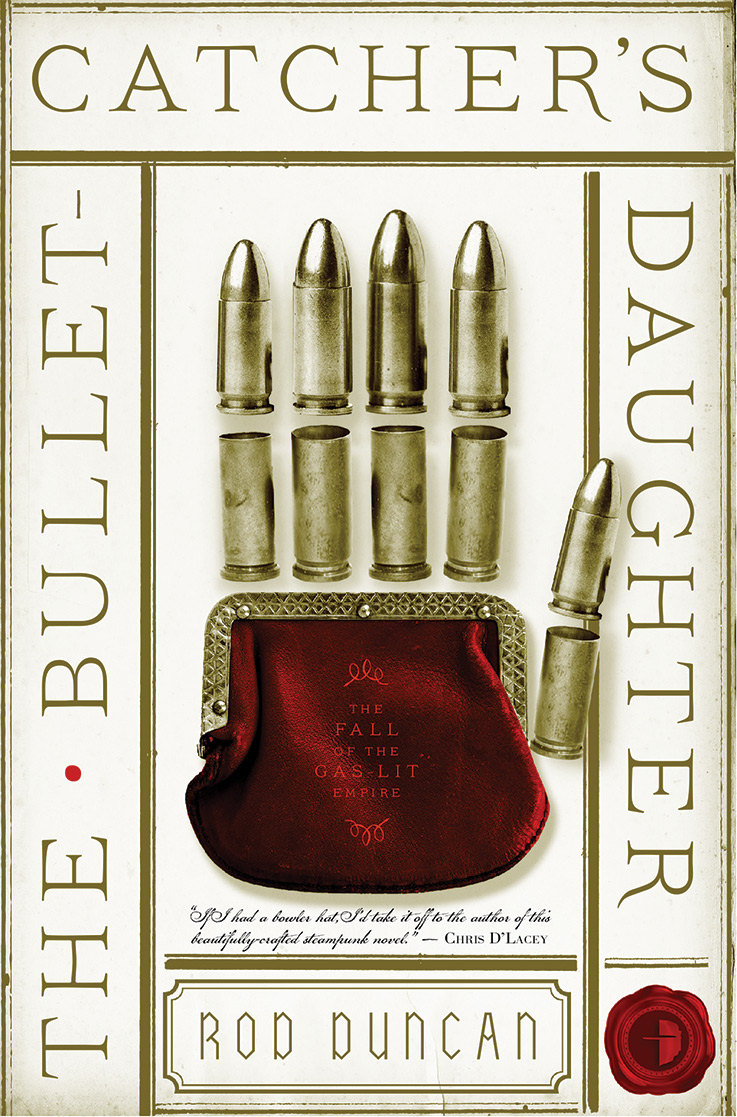
I have been especially impressed by Angry Robots' canny approach to harnessing their readers' passion for 'finding the good stuff' and passing it on. On their website, they are recruiting a 'RobotArmy' of reviewers and bloggers who can 'Take the Robot's Shilling' and download Advanced Review Copies in exchange for an 'honest review' on sites which have their own established genre audience. (Loving the BattlestarCylon references btw in the red-eyed robot logo.) Recently I watched on Facebook as Rod Duncan's new Steampunk novel, TheBullet-Catcher's Daughter garnered dozens of reviews, interviews and blog tours months before the official launch. Gascoigne told us they only have 5 people working for Angry Robot, yet they have hundreds or possibly thousands of committed fans sifting and promoting 'the good stuff'.


So the occasion for this fascinating industry speaker was a book launch of TheBullet-Catcher's Daughter, a new title by Angry Robot. The event was hosted by Leicester Writers' Club and the author was our own Rod Duncan, a long-standing member, previous crime-novelist and well-respected writing tutor. It drew the crowds who rose to the invitation for Steam-punk fancy dress with a gusto that would have endeared the boys from the BigBang Theory. Marc, who delivered an entertaining history of the new genre ('Steampunk is what happens when Goths discovered brown') turned up in the uniform of a Nerd. The rest of us sported hat-pins, airship goggles and scarlet brocade corsets. As ever, I'm grateful to Ambrose Musiyiwa for his photographs which captured the fun and the readers' rapture at Duncan's taster chapter. We snapped up copies, snaffled cake and not a one of us won't have learnt something about how to keep our readers close in the game of 'pass it on.'

Sunday, 25 May 2014

Finding Richard

'Finding Richard' is a little film that's big on story and charm from the production company of Hive Films. I enjoyed today's screening in a gilt-decorated, wood-panelled room at Leicester's Guildhall - the perfect setting. The film features a boy's quest to connect with history - or more importantly with his grandfather - and this take on 'Gulliver's Travels' leads from garden shed to a muddy field to an unexpected tryst. Grandad - aka 'The Professor' - is played by none other than Colin Baker. Appropriately enough for an ex-Time-Lord, he has a shed packed with gadgets and a passion for amateur archaeology. Baker lights up the screen with a gentle energy that draws his young co-star into its warmth. Director Rhys Davies wisely makes this relationship the heart of the film.


 'The Professor' directs a dig to be undertaken by his grandson 'Gull', winningly played by young comedian David Knight (12 years old from Britain's Got Talent). His quest is inspired by the news that Leicester University archaeologists have unearthed the bones of Richard III in a Leicester car-park. Soon Gull is busy with a spade and metal detector, like a one-boy Time Team, in a stretch of rain-soaked football field near Leicester's Tudor Road. He finds a few items of questionable 'provenance' - I'll say no more - but the final scene has a pay-off that knits together his granddad's past and Gull's future in a sweetly understated moment.


I feel sure this film will repay more than one viewing. My own favourite moments and images are Gull's 'tent' in the opening scene with its montage of gothic gargoyles and toy knights; his always off-screen mother shouting up 'Switch that light off Gulliver!', the best cameo by a beseeching dog and the rose china tea-cup granddad sets beside a framed photograph at the end. The upbeat original music matched the warmth of the film's colour palette but gave hints of an undertow of a poignancy as subtle as Baker's performance. Unsurprisingly, this film garnered positive reviews at Cannes Film Festival where it has just been premiered. And with the news that those hotly-contested bones are to be interred in Leicester cathedral, it is destined to find a permanent home in a new dedicated museum.


Personally I find it difficult to be moved by the plight of a feudal monarch. The ill-fated Richard will be accorded a final 'dignity' but I doubt there was much for the lowly tenants and 'men-of arms' who slogged through the slaughter of Bosworth's battlefield. However if it helps people including children to connect to history as Gull did, that's a good thing. And even better this tale - which is 'about a boy' rather than a king - showcases the talents of today's generation. I was delighted to hear from the film's co-writer Douglas Cubin that Leicester's home-grown film industry is burgeoning with several feature films and 10 more 'shorts' underway in the city this year. 'Finding Richard' will surely fly the flag for Leicester's rich cultural output, alongside that raft of musicians who have put the city on TV's map recently. It will delight tourists and locals alike, and its themes about finding your own place in the world through imagination and persistence will resonate with all ages.


Monday, 21 November 2011

House of Horrors


It's worth taking a moment - while decrepit 'granpa' Dodge hollers sour nothings at his wife Halie - to study the extraordinary design of this Curve Studio production. Sam Shepard's darkly comic and disturbing Pullitzer-winning play Buried Child is set in an Illinois rural backwater in 1978. The stage bristles with towering stalks of corn growing out of a giant wooden rack that lifts to become the roof of a prairie homestead. It makes the ramshackle house appear like an underground bunker into which this dysfunctional family have retreated. Earthy roots might thrust through its ceiling any day now. Grimy windows are lit by sloshing rain. Mesh screens partition walls, doors and verandah so that characters seem to move between grey veils. A fine mist drifts across the living room, caught in light shafts which colour with changing hours but also pulse with the emotional undercurrent of this psycho-drama. The whole structure seems creepily alive.

Matthew Kelly & Matthew Rixon

Eventually, Matthew Kelly reels in your attention towards his shambolic patriarch stranded on a filthy sofa that hides more than whisky bottles. Good as he is, the most mesmerising performances from an impressive ensemble cast were the two brothers, Tilden (played by Kelly’s own son, Matthew Rixon) and Bradley (Michael Beckley). As broken as the furniture, these two lumber through interlocking rooms, trapped in the wooden interior. Rixon's portrait is more subtle. A scene where he spreads shelled corn husks over his sleeping father is both clumsily reverent and sinister, funereal even. This is matched by Beckley creeping up on his prone father with an electric shaver. Beckley plays this son as a horror movie grotesque but his twitching angularity and twanging voice are never less than startling. Even grovelling on the sofa, whining for his prosthetic leg, he is menacing. A looming nightmarish figure amidst the grimy realism, you look to him for the violence this play persistently threatens.


With Act Two, the pace picks up as two youngsters arrive; Vince and his girlfriend Shelly. Vince (Lloyd Thomas) is disturbed to find that his father and grandfather fail to recognize him after a six year absence. Except we don't know if they are his family. Shelly, (Catrin Stewart), a brash but winning young city woman, articulates our unease and asks the questions. She eventually concludes it is the house's inhabitants, not her, who are the 'strangers'. Shelly unpicks allusions to a family scandal but the play's title means it's never hard to guess where this is going. What it lacks in mystery though, it makes up in a sullen festering tension.

Lloyd Thomas & Catrin Stewart


Finally, matriarch Halie returns with a bumbling Father Dewis (Gary Lilburn) who might or might not be her beau with his garish bouquet of yellow roses. Jane Lowe, in vintage fifties frocks, blends the faded glamour of a Blanche Dubois with the cracked facade of a Baby Jane. 'I don't know what my role is here,' mutters the priest in a recurring Absurdist complaint about muddled identities. Through the miasma of secrets and confusion, it is the staging which delivers a climactic moment. The cornstalks pierce the rotten heart of the family in an uncanny mutation and Shepherd's armoury of symbols is once more re-arranged.


It seemed only afterwards fitting to tumble into a city under siege from swirling November fog. 'Buried Child' runs till December 3rd at the Curve and deserves full houses throughout for this impressive revival of an American Gothic classic.